

Recent SNAP Changes will Cost the Feds Less by Putting the Burden on Families and States
The One Big Beautiful Bill will cost states more while SNAP participants will receive less


The Supplemental Nutrition Assistance Program (SNAP), formerly known as food stamps, is one of the U.S.’s largest safety net programs. A broad swath of American households, particularly those with children, elderly individuals, or individuals with disabilities, rely on SNAP, and research shows participation can reduce food insecurity, poverty, and improve health and health care use. Recent legislative and regulatory changes to SNAP will restrict its reach and reduce benefit levels, and devolve more of its costs to states. These policy changes provide financial and administrative challenges for states.
SNAP is a federal-state partnership that delivers food assistance to 42 million people each month
SNAP provides cash-like vouchers (via Electronic Benefit Transfers [EBT] cards) to eligible households that can be used to purchase foods to be prepared at home. Federal SNAP spending totaled $99.8 billion, with an average benefit of $187.20 per participant per month, in FY 2024. SNAP benefit levels are determined by household income and household size, and play a substantial role in the resources of low-income families. In FY 2023, the vast majority (86%) of SNAP benefits went to households in poverty; more than half (51%) went to households in deep poverty (income under 50% of the federal poverty level [FPL]).
SNAP benefits and eligibility are set nationally (consistent across the contiguous 48 states). The program has been fully federally funded historically, but states administer the program and recent legislation will increase states’ SNAP costs in the future. To receive SNAP, individuals must apply in the state in which they live and meet certain income and resource eligibility requirements. Currently, household gross monthly income must be under 130% of the Federal Poverty Level ($2,888 for a family of three in 2026) and household net income1 must be under the poverty line ($2,221 for a family of three), with some resource or asset limits.2 Households with elderly individuals or individuals with disabilities may have slightly higher incomes and assets. Most states, however, use Broad Based Categorical Eligibility (BBCE), meaning they align their SNAP eligibility requirements with their Temporary Assistance to Needy Families (TANF, cash welfare) programs, which removes asset limits and allows household gross income up to 200% FPL.
SNAP participants who are considered Able-Bodied Adults Without Dependents (ABAWDs; aged 18-64 without children under 14) are also subject to “work requirements” that limit them to three months of SNAP receipt every three years unless they are working, volunteering, or participating in qualified educational or training activities for at least 80 hours a month. These work requirements were recently expanded in the One Big Beautiful Bill Act (OBBBA) of 2025 and now include households with children aged 14-18 years and individuals aged 55-64, who were previously not subject to work requirements (see discussion below). States have considerable control over SNAP application procedures and requirements, such as whether benefits can be applied for online and how frequently participants must recertify eligibility. Paperwork requirements and other administrative burdens have been associated with reductions in participation.
More than 7 in 10 SNAP participating households contained children, elderly individuals, or an individual with a disability. In FY 2024, an average of 41.7 million people participated in SNAP each month. Nationally, 12.3% of U.S. residents received SNAP at any point across the year, though this rate varied substantially by state (4.8% to 21.2%). In FY 2023, about one-third (34%) of households receiving SNAP included children under 18; another third (33%) were households with one or more elderly individuals, and another 18% of households included a non-elderly individual with a disability. Nearly three-quarters (73%) of SNAP households had incomes under the poverty line.
Nearly half of all children in the U.S. have participated in SNAP at some point before their 18th birthday. More recent research using administrative data in Virginia finds that nearly half of children receive either SNAP or TANF prior to their sixth birthday.
A wealth of research indicates that SNAP participation benefits food security, health, and other outcomes
Like other nutrition assistance programs (e.g., the Special Supplemental Nutrition Assistance Program for Women, Infants, and Children [WIC], free and reduced-price school meals), SNAP is designed to reduce hunger and food insecurity, defined as limited or uncertain access to adequate, nutritious food. Many studies across time and data sources that use methods that can adjust for systematic differences between individuals who participate in SNAP and those that do not find that SNAP reduces food insecurity. Food insecurity is linked to poorer health, and so it is not surprising that research finds that SNAP participation is associated with several health benefits, including reduced mortality. Research on the initial rollout of the Food Stamp Program in the 1960s and 1970s finds evidence that access to food assistance in childhood leads to improved health in adulthood and, among women, an increase in economic self-sufficiency and earnings. Other work indicates that SNAP participation is associated with improved health care use, such as reductions in emergency room (ER) visits, increased preventive care receipt among children, and lower average health care expenditures. Beyond nutrition and health, SNAP substantially reduces poverty, and has economic multiplier effects, with each SNAP dollar generating about $1.50 in economic activity. In turn, the loss of SNAP benefits is associated with increases in food insecurity and poorer health.
SNAP benefit amounts are relatively low, especially in high-cost areas, and monthly benefits distribution causes instability in household resources and purchases
SNAP benefit amounts are based on the Thrifty Food Plan (TFP), a food plan created by the U.S. Department of Agriculture (USDA) that is intended to represent the lowest possible cost needed to support healthy meals and snacks at home, calculated separately by gender and age. The TFP was updated in 20213 which resulted in a 21% monthly benefit increase for SNAP participants. In December 2025, the TFP’s weekly cost was $56.90 and $71.40 for a female and male, respectively, 20 to 50 years of age. (This amounts to $8.13 and $10.20 per day, or $2.71 and $3.40 per meal assuming three meals a day.) In FY 2023, maximum SNAP benefit amounts were $785 per month for a family of three. SNAP benefits averaged $332 across participating households. SNAP benefit amounts for FY 2026 are shown in Table 1.
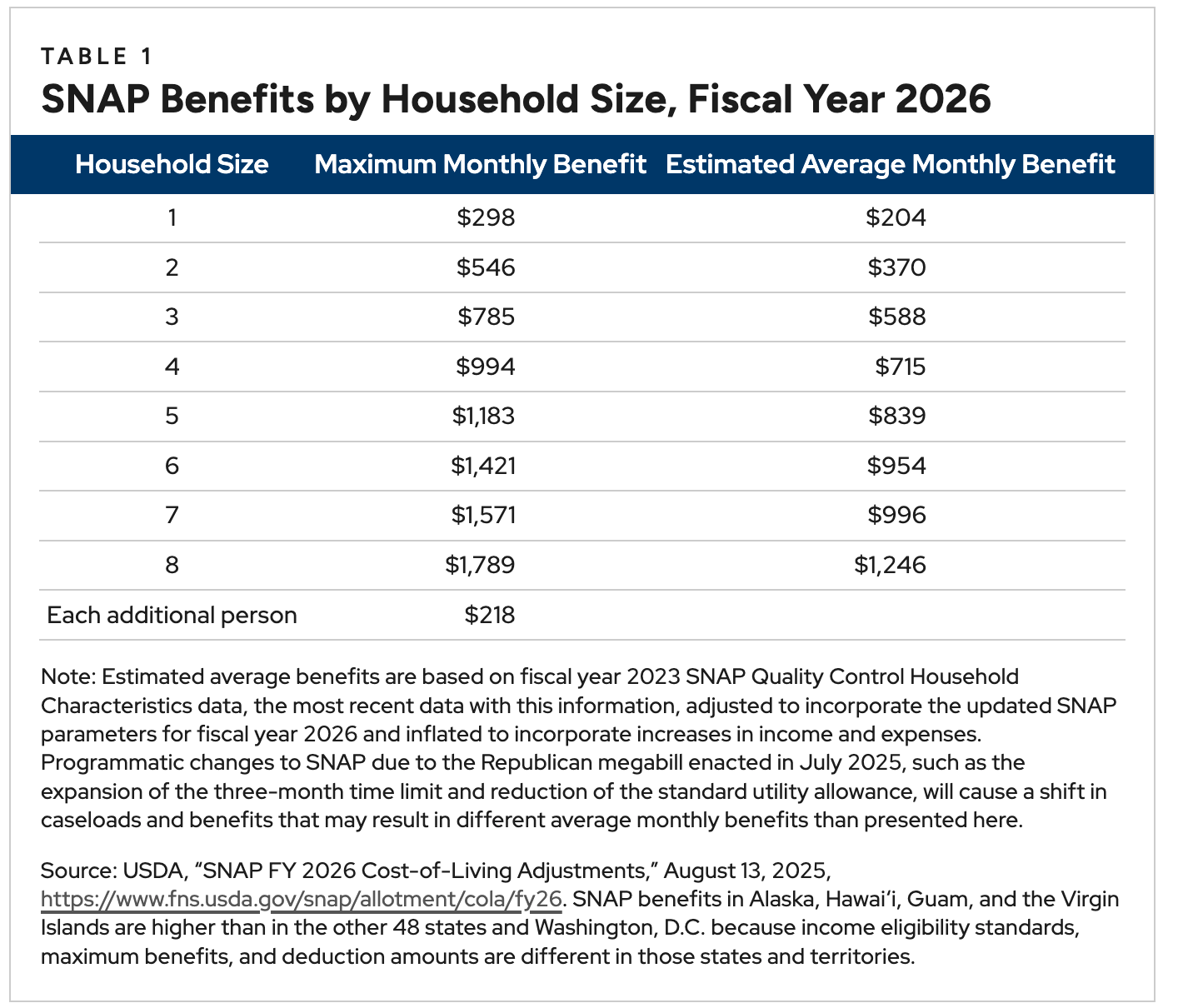
Research indicates that the typical SNAP-participating household’s food consumption and diet quality falls short of nutritional guidelines. Some point to the TFP and SNAP benefit amounts as being too low to support a nutritious diet (even after the 2021 TFP reevaluation), particularly with recent food inflation, noting that benefit levels do not consider the time and labor costs of preparing food at home, nor do they account for different family compositions (e.g. health conditions, age of individuals). Further, because SNAP benefits are fixed across the lower 48 states, their purchasing power varies geographically. Research has found that in areas with higher food prices – places where SNAP benefits don’t go as far – children receive less preventive health care and miss more days of school due to illness. Consistent with this, other studies have found that the temporary SNAP benefit increase in the American Recovery and Reinvestment Act (ARRA) of 2009 reduced food insecurity and delays in needing but not being able to afford health care, and that higher SNAP benefits reduce ER visits for hypoglycemia. Beginning in January 2026, the Trump Administration allows states to apply for SNAP Food Restriction Waivers to prevent the purchases of foods like soda and candy using SNAP benefits.
SNAP benefits are distributed once monthly, leading to within-month instability as resources run low at the end of a benefit month. On average, SNAP households expend three-quarters of their benefits in the first half of the month; one-quarter of SNAP households redeem nearly all of their benefits in the week following receipt. Research has linked this SNAP benefit cycle to within-month variation in food and other purchasesanddietquality, as well as ER visits, the incidence of crime, student disciplinary infractions, conflict in the home, self-reported well-being, and children’s SAT and end-of-year exam scores.
Recent policy changes have restricted SNAP participation and benefits
The One Big Beautiful Bill Act (OBBBA), signed into law in July 2025, will bring multiple, dramatic changes to the SNAP program – changes that will shift costs from the federal government to low-income households and to states. These changes include:
Expansions in work requirements, which will reduce SNAP participation, in four main ways: (1) raises the age of ABAWDs subject to the 80 hour per month work requirement from 55 to 64, requiring older adults to engage in work activity; (2) restricts states from requesting waivers for ABAWD work requirements due to high unemployment rates; and (3) expands work requirements to parents whose youngest child is 14 years or older, down from 18 or older. Prior research shows that many of those subject to these expanded requirements already work or are caring for others, but reporting work activity, particularly for the many low-income workers who work variable schedules that fluctuate from week to week, will be challenging. Studies indicate that these work requirements, via the paperwork involved in proving work activity, reduce SNAP participation through increased administrative burdens. Indeed, reduced SNAP participation – both from those meeting eligibility requirements and those that do not – due to increased administrative burdens is one of the ways the OBBBA is expected to cut federal SNAP spending.
Reductions in SNAP benefits. The TFP had been scheduled to be reevaluated (and presumably increased to reflect inflation) in 2027 and 2032; the OBBBA prohibits these TFP updates, essentially preventing changes to the TFP and SNAP benefits. The OBBBA also eliminated the allowances for households receiving energy assistance (heating and cooling) and for internet expenses when calculating SNAP benefit amounts. Together, these changes mean that, beginning in 2027, the average SNAP benefit is likely to be smaller than it would have been without the OBBBA.
Increases in states’ costs. Whereas SNAP has been fully federally funded (and state-administered) since its inception in the 1960s, states will have to kick in for food benefit costs based on their “payment error rate,” a measure of how accurate a state’s eligibility and benefits determination processes are. Importantly, this payment error rate focuses on overpayment, not underpayment (cases in which individuals should be receiving SNAP but are not, or when recipients receive less than they should in program rules), so state administrators will have an incentive to be more restrictive when determining SNAP eligibility or benefit amounts. Beginning in 2028, states with payment error rates of 6% or higher will pay at least 5% of SNAP benefits costs. Because payment error rates vary from year to year, this will cause unpredictable expenses for state governments. In its forecasting of the OBBBA’s effects, the Congressional Budget Office (CBO) expects that some states will maintain benefits and eligibility while contributing state funds, while others will reduce benefits or eligibility or even leave the program altogether. The OBBBA also reduces federal support for administering SNAP – costs involved in enrolling and re-enrolling of individuals and of getting benefits to participants (e.g., the website, staffing) – from 50% of administrative expenses to 25% of operation costs beginning in 2027, meaning that states will have to shoulder these expenses, too.
Finally, the OBBBA restricts SNAP eligibility to U.S. citizens or lawful permanent residents. This occurred immediately upon the law’s signing (July 2025) for new and recertifying applicants, for which states must verify immigration status. Prior, certain types of documented immigrants (i.e., those meeting eligibility requirements who had completed a 5-year waiting period) were eligible for SNAP. In late July 2025, the Administration released guidance that requests data from states on SNAP applicants over the past 5 years, including names, dates of birth, Social Security numbers, addresses, and other information used to determine eligibility. Individuals who meet SNAP eligibility requirements in mixed-status households remain eligible, but may be deterred from applying.
In addition to these legislative changes, the federal government shutdown in fall of 2025 led to a delay in SNAP benefits. After the shutdown began in October 2025, the USDA instructed states to pause November benefits and prohibited contingency funds from being used for SNAP. After a federal judge ordered benefits to resume by October 31, the USDA paid only partial benefits. Research on the effects of other shutdowns (e.g., the December 2018 – January 2019 shutdown, during which February benefits were disbursed early in January, leading to an extended gap before March benefits were disbursed) indicate that the uncertainty of SNAP benefits had cascading effects and created challenges for household finances.
Because of the 2025 government shutdown, the USDA delayed the three-month window to comply with the OBBBA’s new work requirements. SNAP participants who had their eligibility redeterminations in November and December 2025 have until the end of February 2026 to comply with the minimum 80 hours per month of work activity; those that do not meet these requirements or prove they are exempt (e.g., document a disability) will lose benefits in March 2026.
SNAP, and changes to SNAP, affect other public programs
Recent policy changes to SNAP come alongside changes to other public programs that many SNAP participants rely on, particularly health insurance. In 2022, more than three-quarters (78%) of SNAP participants were covered by Medicaid, including 18% who were elderly and covered by Medicaid and Medicare. Medicaid was cut dramatically by the OBBBA, with an estimated 7.8 million individuals losing coverage by 2034. Together, this means some SNAP participants who are enrolled in Medicaid may lose both their health insurance coverage and their resources to purchase food.
As the benefits from and participation in traditional cash welfare (Temporary Assistance to Needy Families [TANF]) has waned over the last three decades, SNAP and Medicaid, along with tax credits, have taken on more important roles in the social safety net. The cuts to SNAP and Medicaid will likely increase poverty, particularly among the young and older adults prior to Medicare eligibility (age 65).
Policymakers have opportunities to make SNAP stronger
First, states and localities can reduce administrative barriers to SNAP enrollment and re-enrollment. This means adopting Broad Based Categorical Eligibility (BBCE), simplifying application paperwork, eliminating asset tests, and extending recertification time periods, among other changes. States may seek to streamline the process for reporting work requirements and documenting exemptions (e.g., caring for a young child or incapacitated person) as much as possible, and institute monthly vs. weekly reporting to (try to) account for work schedules that vary from week to week. These state-level changes may have implications for the effects of other social programs. A (longer-term) option to expand SNAP participation is to repeal the work requirement expansions and eligibility restrictions to citizens/permanent residents in the OBBBA.
Second, policymakers could expand access to SNAP benefits by “smoothing” the existing eligibility threshold, more gradually phasing out SNAP benefits as income increases, more similar to the structure of the Earned Income Tax Credit. This change, in addition to removing asset limits, can help combat the “benefit cliff effect” such that a small increase in income creates a substantial reduction in or loss of benefits that may exceed the increased income, resulting in lower total household resources.
Third, higher SNAP benefit levels – particularly benefit amounts that are adjusted to the local cost of living – could improve food access and quality among participating households. Research has found that the temporary increase in SNAP benefits following the ARRA smoothed food intake over the benefit month. Similarly, SNAP benefits were temporarily expanded during an emergency allotment during the COVID-19 pandemic, which increased SNAP recipients’ spending on food to be consumed at home (i.e., groceries) and reduced food insufficiency. At the federal level, policymakers could repeal the restriction on updating the TFP, and even elect to tie SNAP benefits to the USDA’s Moderate Food Plan, which is likely a more realistic representation of food spending than the TFP. Further, policymakers may seek to eliminate states’ SNAP Food Restriction Waivers to reduce the administrative burdens on SNAP-participating stores and stigma for households.
Another way to increase SNAP benefits is to subsidize healthy foods like fresh fruits and vegetables, which typically cost more than processed food items but for which households are particularly price sensitive. States may apply for SNAP Healthy Incentive project waivers from the USDA to use state, local, or private funding to increase benefits specific for vegetables, fruits, whole grains, or dairy foods.
Fourth, beyond expanding SNAP benefit amounts, policymakers could expand (vs. restrict) the items eligible for SNAP. While SNAP benefits are “cash-like” they are not fungible like cash, and many household essentials – including toothpaste, toilet paper, and diapers – cannot be purchased with SNAP benefits.
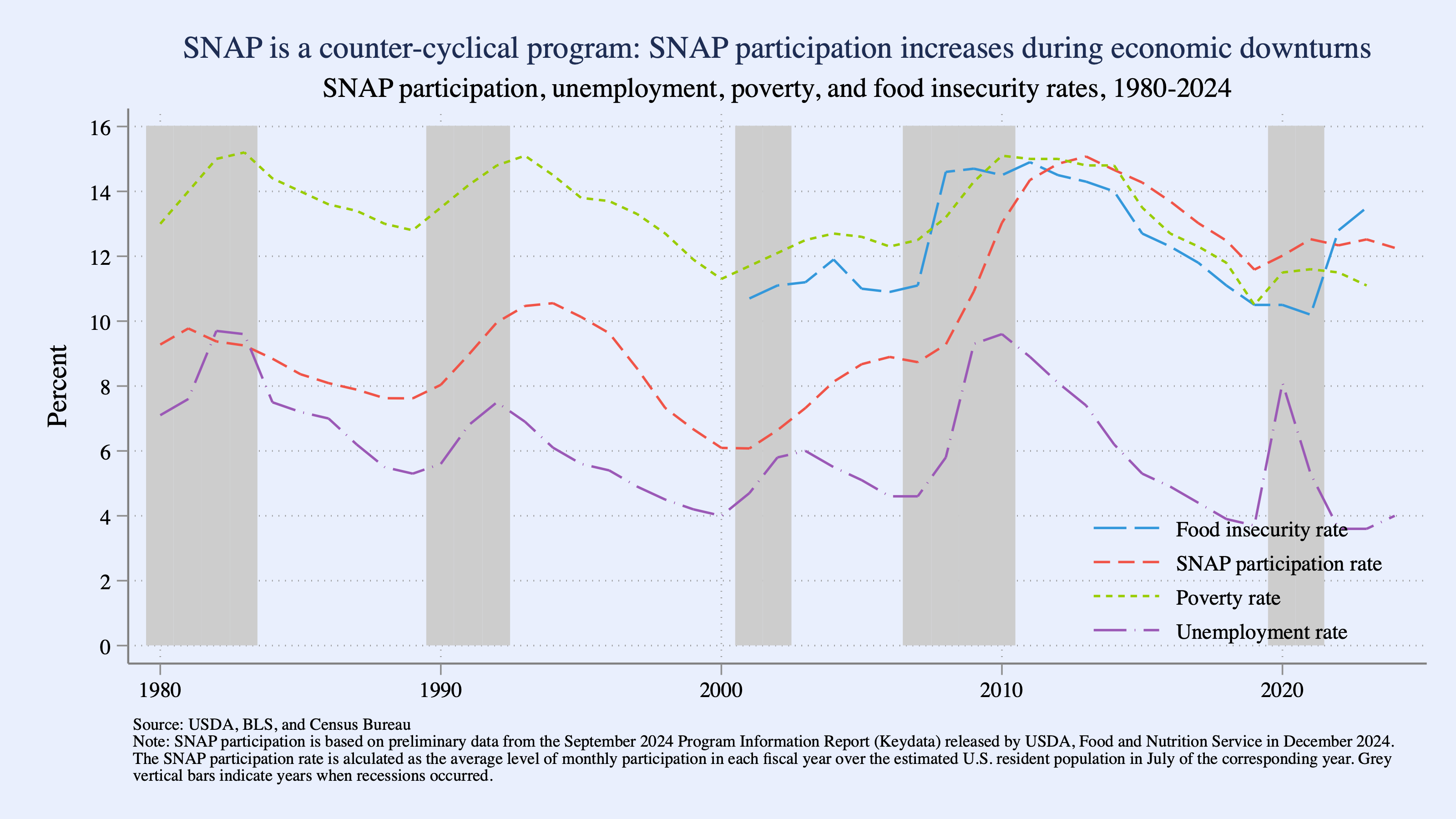
State budgets are currently strained and likely to become more so as the OBBBA increases state costs and reducesrevenues. SNAP is a counter-cyclic program, meaning SNAP participation increases during economic downturns (see Figure 1). If states need to balance their budgets, economic downturns can lead to worse financial situations for states at the same time that the food security of low-income households is strained. A repeal of the OBBBA provisions regarding states’ share in benefit and administrative costs would require federal action.
Conclusion
In sum, SNAP serves a wide range of American households, with 7 in 10 participating containing a child, an elderly individual, or an individual with a disability. SNAP participation reduces food insecurity and improves health care use and health, and higher benefit amounts could increase the program’s benefits. Recent policy changes, particularly those in the OBBBA of 2025, restrict SNAP participation, reduce benefits, and increase states’ costs.
The following deductions are allowed for SNAP: 1) 20% deduction from earned income; 2) A standard deduction of $209 for household sizes of 1 to 3 people (higher for some larger households and different for households in Alaska, Hawaii, the U.S. Virgin Islands, and Guam); 3) A dependent care deduction when needed for work, training, or education; 4) Medical expenses for elderly or disabled members that are more than $35 for the month if they are not paid by insurance or someone else; 5) In some states, legally owed child support payments; 6) A standard shelter deduction for homeless households of $198.99; and 7) excess shelter costs. For more information, see: https://www.fns.usda.gov/snap/recipient/eligibility.
Households may have up to $3,000 in countable resources (including cash or money in a bank accounts (excluding homes, public assistance, and most retirement or pension programs). Households with an elderly individual or one with a disability must only meet the net income limit and may have up to $4,500 in countable resources.
Prior to 2021, the TFP had not been updated since 2006.
 | A guest post by
|
We read a @farmanddairy.com column that in November 2025 SNAP was expected to spend $100B nationwide. Farmers and ranchers and rural communities across the country might have seen $20B to $25B of those SNAP dollars spent on local produce. But Trump's WH told county FSA's to divide $3B in direct payments to around one million farmers and landowners while he figured out how to cut 43M beneficiaries out of the $8B monthly SNAP they were qualified to receive. In the end, farmers received less, county's had over-head, and all those beneficiaries went hungry. Adding in a work requirement for disabled, elderly, and Veteran recipients really took the cake.
Thanks for this terrific article. Posted to Center on Capital & Social Equity blog: www.inequalityink.org K Polzer