

Putting a Price on Permitting
When anyone can say no to new housing, developers will pay up for an automatic ‘yes’.


There are a variety of regulatory barriers to housing development, from zoning restrictions to permitting delays and hassles, but separating the effects of each has been nearly impossible.
In Los Angeles, however, around one in five land listings come with “ready-to-issue” permits attached, creating an implicit market for development approval. In new research, we use this market to produce the first estimate of permitting costs.
We find developers pay a 50-percent premium for pre-approved land relative to otherwise equivalent raw land — roughly $770,000 for a typical building site — and that permitting accounts for about one third of the gap between home prices and construction costs in the city. Buying preapproved land also saves developers around two years from site acquisition to completion, not because total time falls, but because someone else has already waited.
How can local governments reduce permitting costs? We have two main recommendations. First, while many cities publish “open” data on building permits, few include the basic information needed to measure a standardized time-to-permit and time-to-build. This low-cost tweak could inform and improve future governance.
Second, we argue the root problem is institutional design, not inadequate public resources for permit review. That is, the status quo of discretionary review and hyperlocal vetoes fundamentally engages the wrong political actors at the wrong time. We review the theoretical rationale and empirical evidence that leads us to favor broad rules over project-level discretion (“as-of-right” permitting) as well as centralizing permitting decisions at the mayoral level (abolishing hyperlocal permitting authority, such as “aldermanic prerogative” or “member deference” on city councils).
Economic foundations: the tragedy of the anticommons
Why is permitting so costly in cities like Los Angeles? We see it as a case of the “tragedy of the anticommons,” the mirror image of the more familiar tragedy of the commons. Where the commons problem arises when too many people can use a resource, the anticommons problem arises when too many parties hold veto power over a transaction. When everyone can say no, mutually beneficial deals can fail to happen.
Under discretionary permit review — the standard in Los Angeles and some other high-rent cities — building an apartment complex of meaningful size requires approvals from multiple bodies: neighborhood councils, planning commissions, environmental review boards. Any one of them can compel changes or delay the process.
These complications not only add cost and risk, but they also create points of “hold-up” leverage against housing development. Economic theory has explored how, with private information about project value, such hold-up can be destructive, stopping deals that would be profitable even after transaction costs. We ultimately view such bargaining as rent-seeking competition over the surplus value created by other land-use constraints.
Journalists and policy researchers have documented dysfunctional bargaining outcomes in many real-world cases of permitting. In San Francisco’s Mission District, for example, one developer proposed to build 75 new apartments. He ended up spending a decade arguing about whether he could tear down a supposedly “historic” laundromat.
Developers pay a 50-percent ‘approval premium’ for permitted land
In equilibrium, the cost of permitting for the marginal project should equal the approval premium — that is, the incremental value of land with permits over its value without them. If approved land were too expensive, that is, developers would “make” the permits themselves. Too cheap, and every developer “buys” the permits.
To measure the value of a completed permit, we compare changes over time in listing prices of properties that experienced a change in their permit status. Differences in prices over the change in permit status provides a measure of the value the market places on the permit. To control from general trends in prices over time unrelated to permits, we also net out changes in prices over the same time period across listings that remain raw land.
We find developers pay 50 percent more for preapproved land than for otherwise-equivalent raw land. In dollar terms, that is $48 per square foot — roughly $770,000 for the typical building site, and about 36 percent of construction costs.
Figure 1. Land with Approved Permits Command Substantial Premiums
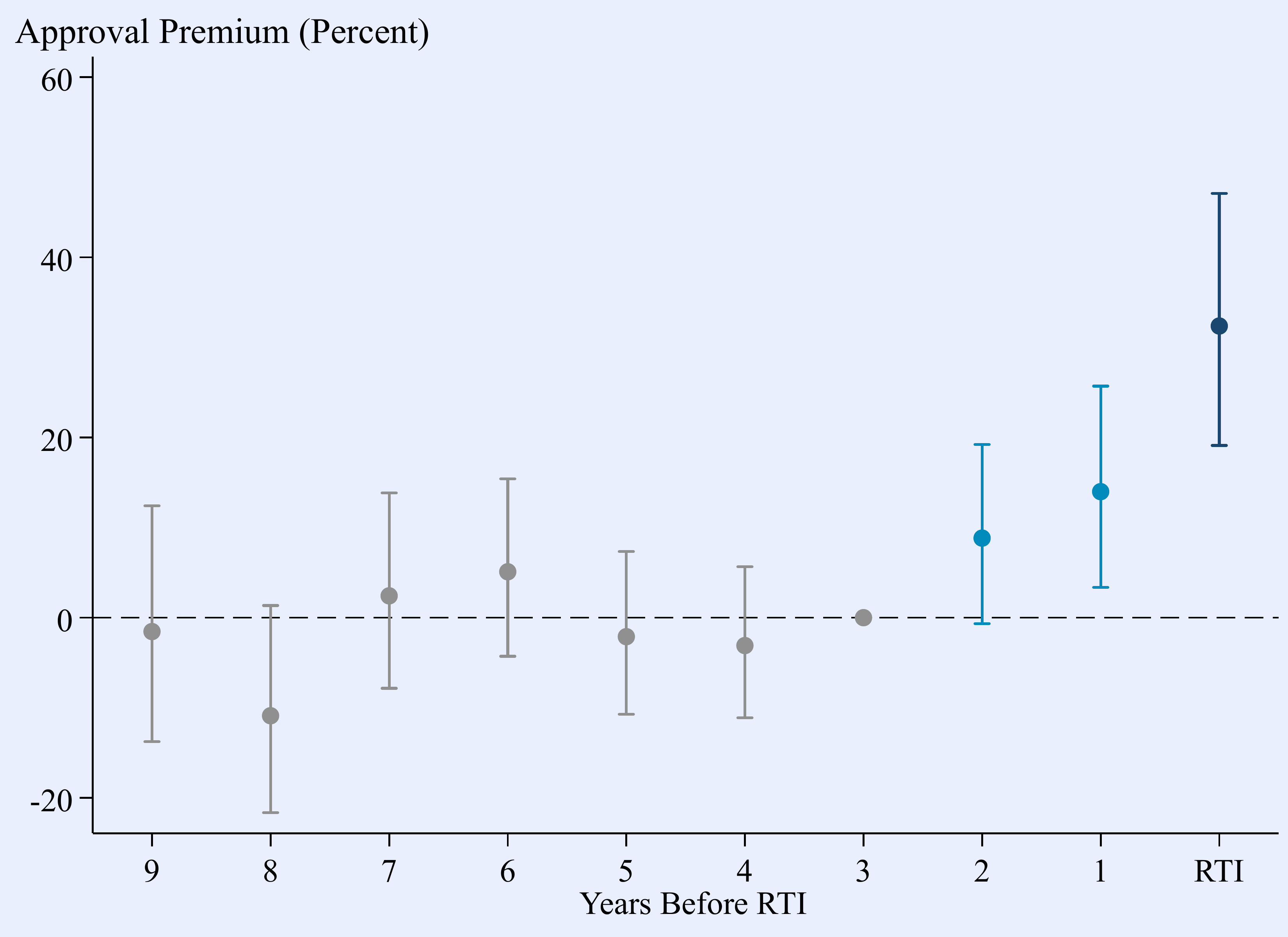
Note: Dots report event study estimates of price premiums for land that eventually receive permitting approval, by year prior to the ready-to-issue (RTI) permit approval. The reference period is three years prior to the RTI listing. The figure includes nine lead years before being fully approved. To estimate the approval premium, the event study compares changes over time in listing prices of properties that experienced a change in their permit status, controlling for contemporary price trends observed for listings that remain raw land. Bars indicate 95-percent pointwise confidence intervals, with standard errors clustered by parcel.
While these figures appear sizable, they might be small relative to the distortions that other land-use regulations create. Our data allow us to directly address that critique.
Following Glaeser and Gyourko (2003), the total regulatory tax on housing can be measured as the gap between home prices and construction costs. If land markets are roughly efficient, then this home price-construction cost gap is capitalized into the value of raw land. The approval premium goes on top of raw-land value. By this logic, comparing the approval premium to raw-land value pins down the permitting share of the regulatory tax. We find permitting can account for approximately one third of the home price-construction cost gap in Los Angeles.
The permit approval premium reflects avoided wait times and hassle costs
The permit approval premium has two components. The first is pure wait: permitting in Los Angeles takes roughly two years for the median project, accounting for 40 percent of the total time from site acquisition to receiving a certificate of occupancy. Overall, a 30-unit apartment building takes approximately 4.2 years to complete in Los Angeles, twice as long as in Raleigh or Fort Worth.
The second component is capitalized hassle: the compliance expenditures, legal fees, and plans that developers draw up during the review process.
To say how much might be pure wait versus hassle, we link listings to permit outcomes. By comparing projects on preapproved and raw land, we estimate projects on preapproved land are 8 to 12 percentage points more likely to complete construction within four years.
That effect is a 30-percent increase over the counterfactual four-year completion rate of 35 percent, for an average time savings of roughly two years. At standard discount rates, pure wait can account for roughly half of the premium, with the rest reflecting hassle.
Figure 2. Construction on Pre-approved Land is Completed Faster
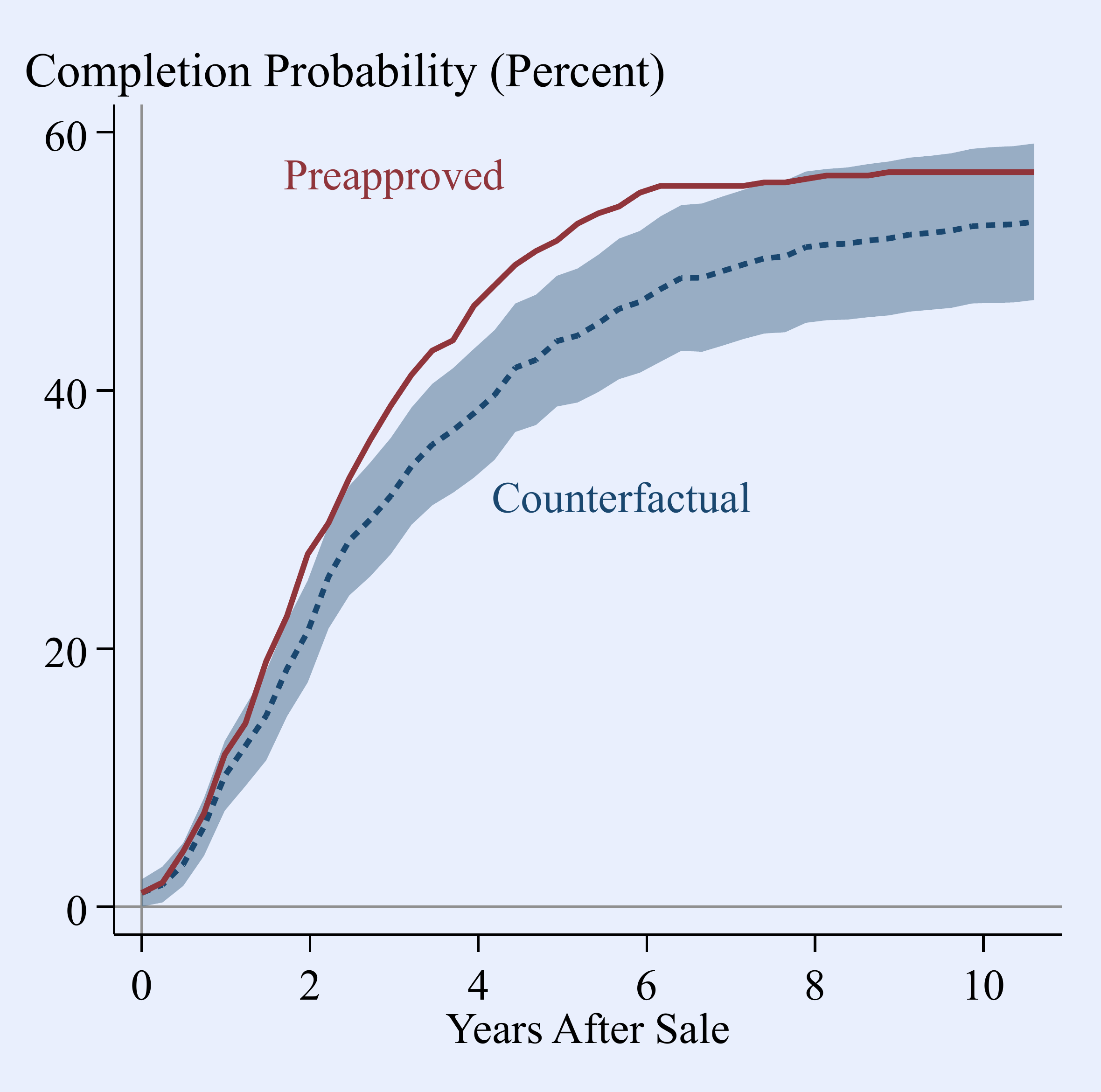
Note: This figure displays the estimated effects of preapproval on time to completion. Specifically, it plots the empirical cumulative completion hazard for preapproved properties (red solid line) and then subtracts off the estimated effects of preapproval to obtain the counterfactual completion profile in time (blue dashed line) The sample is all vacant properties that ever submit a permit. Color bands indicate 95-percent pointwise confidence intervals, with standard errors calculated by a nonparametric bootstrap clustered by property.
These results suggest that preapproval effectively creates a “market for time.” For every year that developers save once they buy preapproved land, we estimate landowners spend an extra year in permitting. That is, preapproval changes who waits, without changing total time spent.
Who preapproves land?
Our research uncovers a specialized subsector of the Los Angeles real estate industry that has emerged and takes permitting as its comparative advantage, carving off a task distinct from construction. These are short-term landowners — permit-flippers — who buy raw land, navigate approvals, and sell rather than build.
We show this in two ways: by looking at land investor holding periods, and by identifying the landowners through their property-tax mailing addresses.
First, we find much higher preapproval rates among properties with holding periods of two or three years than ten. This pattern mirrors the behavior of short- versus long-horizon investors in other asset markets.
Second, the landowners who pursue preapproval on one site use this strategy more than 60 percent of their other land holdings. That fraction is around 50 percentage points higher than one would predict using the neighborhoods in which the owners and parcels are located. In short, preapproval is a business, not an accident.
The geography of permitting costs
One might expect permitting to matter most in lower-rent neighborhoods, where developers are less constrained by limits on how intensively they can use land. The data suggest the opposite.
Los Angeles County spans neighborhoods where housing is very dear and ones where most of the stock is highly depreciated. In economically-distressed South Los Angeles, home prices are roughly at par with construction costs. Consistent with this, developers are willing to pay essentially nothing for a permitting shortcut there. The regulatory tax is low because the market cannot bear it.
Figure 3. Permitting Is Most Burdensome In Places Where Housing Prices Greatly Exceed Construction Costs
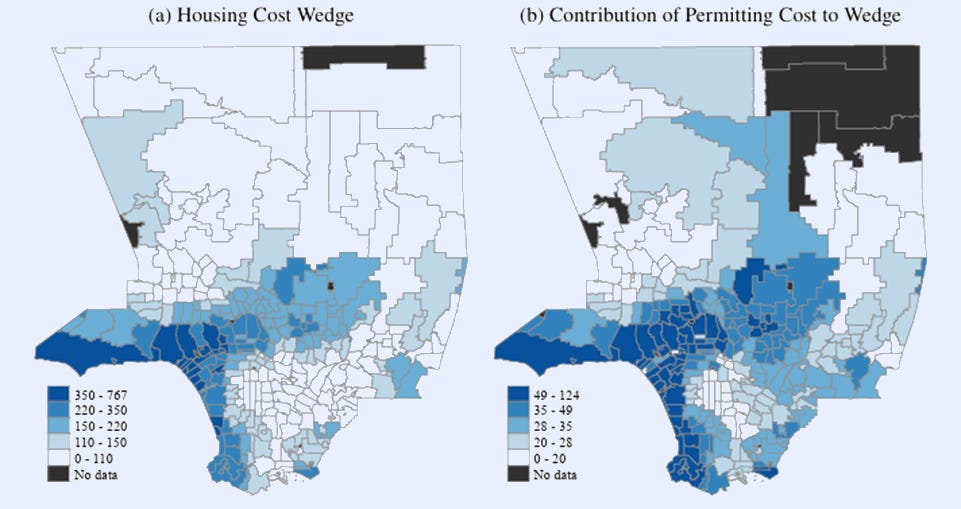
Note: This figure displays zipcode-level estimates of the median wedge between rents and construction costs (Panel A), and the model-implied contribution of permitting costs to this wedge, reported as a percentage of construction cost (Panel B).
But in high-rent neighborhoods like Santa Monica, where home prices exceed construction costs by more than two to one, developers are willing to pay around 85 percent of construction costs just to skip permitting. Permitting is thus a major driver of the construction costs in places where other regulations already heavily distort housing supply.
What this means for permitting reform
While our results directly address the problems of one U.S. city, we think policymakers beyond Los Angeles might draw several lessons from our research.
For federal policymakers, the most actionable implication is data infrastructure. The Census Survey of Construction surveys developers on time from permit issuance to completion but omits the pre-issuance phase, which our research shows is important. A modest redesign to capture the full timeline would allow researchers and officials to track permitting costs across cities and over time.
For local policymakers, the key question is whether their city tracks the full permitting timeline: from a developer’s initial engagement with planners through to certificate of occupancy. Most cities post permit data online, but many are missing key dates. Without the complete picture, it is challenging to assess the performance of city practices.
Most fundamentally, our results raise two deeper governance questions that have been considered in scholarship on law and economics as well as fiscal federalism. First, to what extent should building permits be awarded by rules versus discretion? Second, at what level of government should permitting authority sit?
The classic tension between rules and discretion is that the decision-making agent (the government) has incentives that are better aligned with the principal (society) on a rule-level basis rather than case-by-case. However, governing by rule forgoes valuable case-specific information.
Under “as-of-right” (also known as “by-right” or “ministerial”) permitting, if a project satisfies predetermined rules, a city is obligated to issue the permit. Many jurisdictions are moving toward rules-based permitting. In California and Massachusetts, for instance, recent reforms have recently expanded as-of-right permitting, respectively for “infill” development and accessory dwelling units. While research has found speed benefits of rules-based permitting, we are not aware of empirical research that measures the benefits of discretion.
Turning to fiscal federalism, the canonical trade-off is between internalizing spillovers across jurisdictions and accommodating local preference heterogeneity. In the housing context, new construction is often genuinely disruptive to existing residents, and their concerns deserve a voice. But in spatial equilibrium, people benefit from more housing in places where they will never live — and where they will never vote.
Hyperlocal permitting authority, variously called aldermanic prerogative in Chicago or member deference in New York, puts undue weight on incumbent residents relative to everyone else. Recent research suggests that reallocating this authority to officials with broader constituencies, as at the state or regional level, could increase housing production.
The challenge is doing this while protecting democratic voice and disadvantaged communities from bearing disproportionate costs. But that challenge argues for thoughtful reforms, not for preserving the status quo — which is failing on all three counts: housing production, democratic voice, and minority protection.
 | A guest post by
|
 | A guest post by
|
Great research. Underscores one of the benefits of Japan's system, which includes by-right permitting: https://us-jf.org/hubfs/dutta-gupta-leveraging-lessons-from-japan.pdf?hsLang=en
Good analysis of one party's (developer's) perspective. How about analyzing the rest of the parties perspectives on the impacts and cost of permitting. Oh yes, the business of getting permit per-approvals and up-zoning used to be called speculation and was often accompanied by corruption of governmental employees. Narrow large benefit (developer) hitting narrow choke point (person with approval authority) causing wide spread but small costs (community owners/tenant consumers)